


Technology
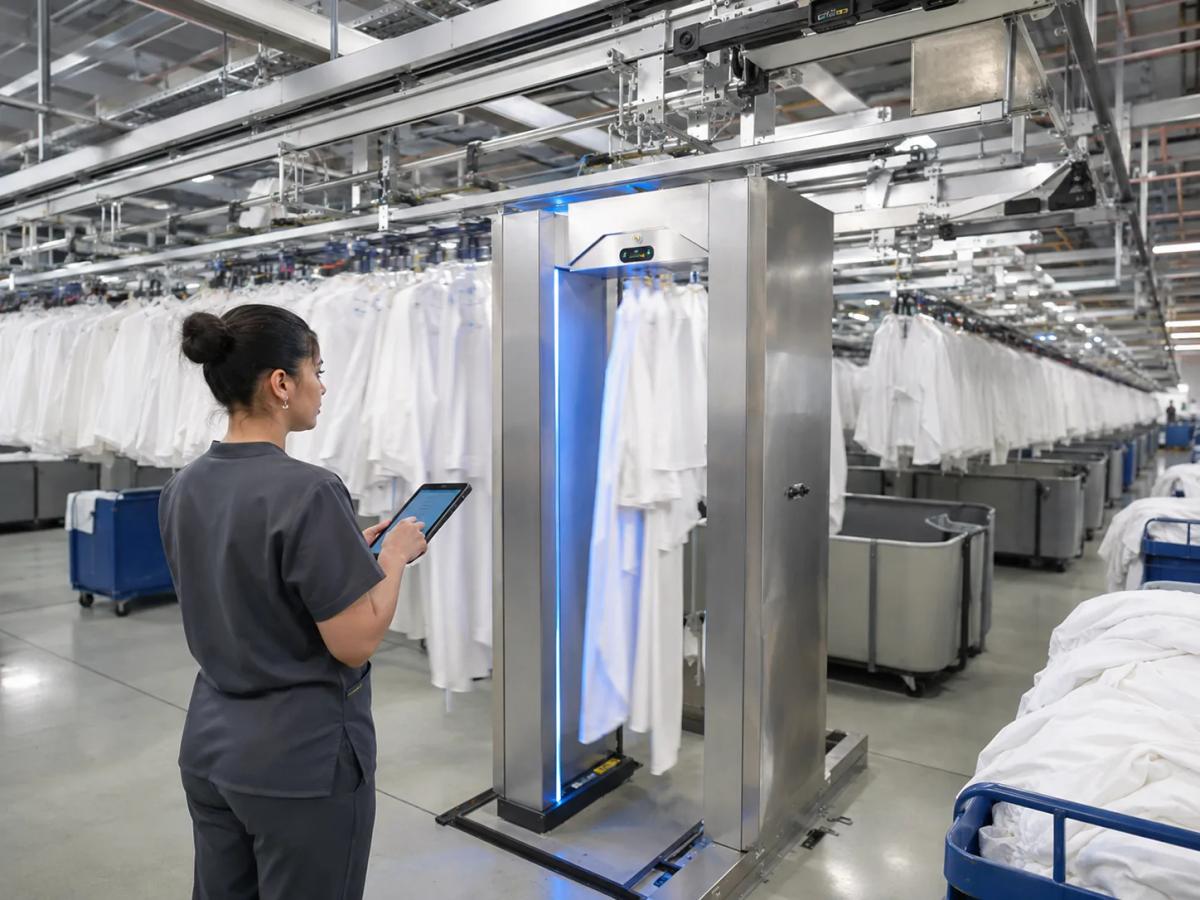
RFID technology optimises textile operations through precise material and product tracking.
How RFID works
RFID, or Radio Frequency Identification, enables the automatic identification of individual textiles using small tags embedded directly into garments, towels, bed linens, workwear, or other reusable textile products. Each tag carries a unique identifier that can be read by an RFID reader when the textile passes through a defined reading area.
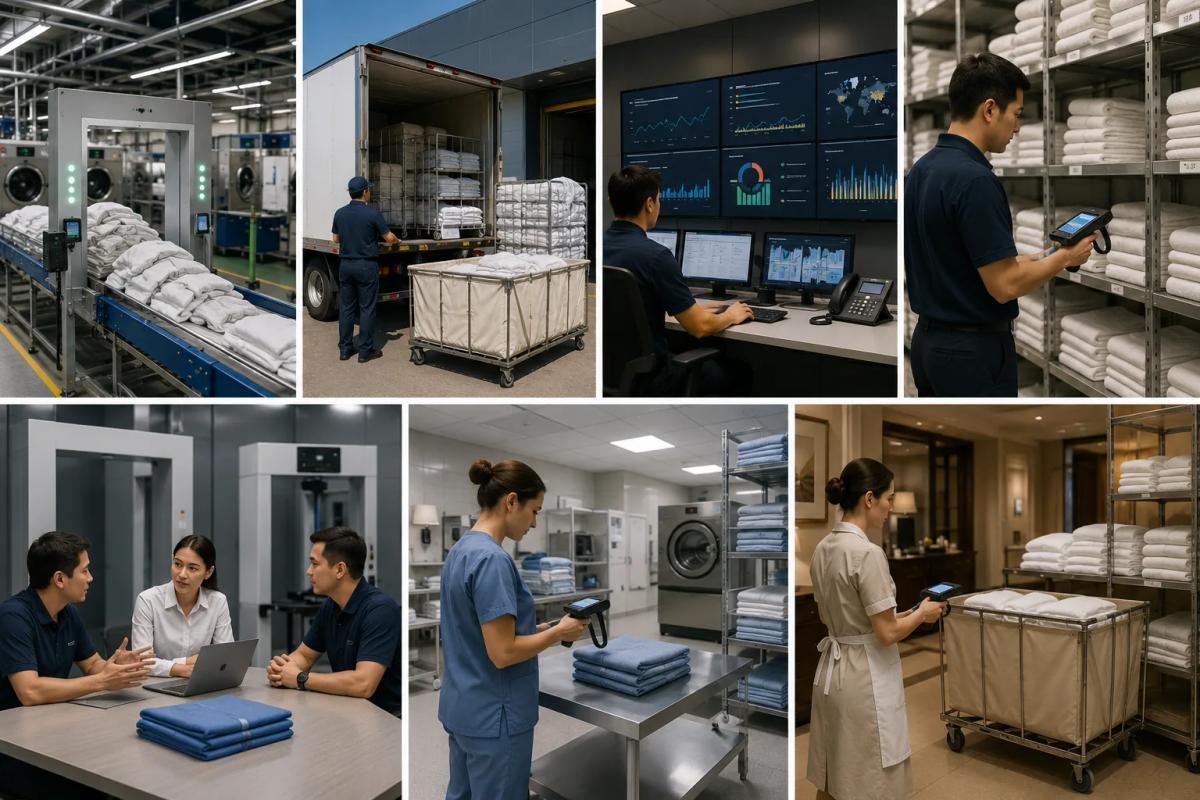
Unlike traditional barcode systems, RFID does not require each item to be manually positioned in front of a scanner. Depending on the setup, multiple textiles can be detected simultaneously as they move through the process. Each detection generates a digital event. This event can be linked with information such as textile ID, current or last known location, customer assignment, number of wash cycles, processing history, circulation status, and dwell time in specific process stages. Together, these events create a digital history of how each textile moves through the operation.
Process visibility
Tracking tells you where something was detected. Process visibility explains what that detection means. This distinction is important. A simple tracking system might answer: Where was this textile last scanned? A process-oriented system can answer: Why is this textile still here? Why are hundreds of items accumulating in one place? Why do certain customers hold more textiles than expected? Why has the throughput time increased this week? Here, RFID becomes more than just a location technology. When textile movement is linked with operational context, RFID helps teams understand how effectively the entire process is functioning. Instead of merely collecting scan events, organisations can identify patterns, delays, deviations, and recurring operational issues.
Receiving & sorting
The first critical capture point often begins when used textiles return from a customer site. In a traditional workflow, returned items may need to be manually counted, sorted, or recorded before processing begins. This presents several challenges. Manual counts can be inconsistent. Missing textiles are often discovered much later. Customer-specific return patterns are hard to compare. RFID can automate much of this process. When textiles enter the facility, readers can capture incoming items and compare them with expected quantities. Operators can immediately see: how many textiles returned, which customer they belong to, which items are missing, how quickly stock is returning, and whether unusual patterns are occurring. This allows deviations to be detected much earlier in the textile cycle.
Textile circulation
After receiving and sorting, textiles pass through several operational stages before they are ready for reuse. A typical cycle might include: receiving → sorting → washing → drying → finishing → storage → dispatch. Depending on the operation, additional steps such as quality control, repair, sterilisation, picking, or customer-specific preparation may be included. Strategically placed RFID readers capture movement between these stages. This allows measurement of how long textiles remain in each process section. For example, if textiles usually move from washing to finishing within two hours but suddenly remain there for six hours, the system can indicate an unusual delay. Without this visibility, teams often notice the problem only when clean stock is unavailable later. Process data enables earlier investigation of delay causes.
Distribution & locations
For textile service providers, a large portion of stock is often outside the laundry itself. Textiles may be located in hospitals, hotels, industrial facilities, distribution centres, transport vehicles, or temporary storage. This creates a distributed inventory environment. Without reliable tracking, operators know how many textiles they have purchased but not where they actually are. RFID helps create a clearer picture of stock distribution. Teams can identify: textiles currently in the laundry, items assigned to customer sites, stock awaiting transport, textiles remaining longer than expected with customers, locations with unusually high quantities, and items not returned in the normal cycle. This information greatly improves inventory planning. Often, an apparent shortage is not caused by missing stock. The textiles already exist but are simply in the wrong place in the cycle.
Operational KPIs
RFID systems generate vast amounts of data. Operational teams do not need to see every scan but must understand the metrics that explain process performance. Some of the most valuable KPIs include: textiles in circulation – the total number of active textile items in the system, clarifying available stock; throughput time – the time a textile takes for a defined process cycle; increasing times may indicate bottlenecks or inefficiencies; wash cycles – the number of washes a single textile has undergone, supporting lifecycle management and replacement planning; loss rate – the percentage of textiles lost from expected circulation; changes help identify recurring problem areas; process dwell time – the time textiles spend in a process stage; long times can reveal hidden bottlenecks; location distribution – the number of textiles at customer sites, warehouses, process stages, and transport routes; customer inventory – the volume of textiles assigned to each customer or location. Together, these metrics provide a comprehensive view of operational performance.
Identifying bottlenecks
Operational bottlenecks are not always easy to spot. A laundry may have sufficient equipment, staff, and textile stock yet still experience delays or bottlenecks. The actual problem may lie elsewhere. For example: a sorting area operates too slowly; a customer holds stock longer than expected; clean textiles accumulate in storage instead of being dispatched; transport schedules cause unnecessary waiting times. Without process visibility, the simplest response is often to increase stock or capacity. This can raise costs without solving the root cause. RFID data helps pinpoint where the process slows down. By measuring textile quantities and dwell times at different stations, teams see where items accumulate.
Reducing textile loss
Textile loss is one of the most costly challenges in professional textile operations. Losses rarely occur at an obvious point. Textiles can gradually disappear across many process stages. They may remain at customer sites, enter incorrect distribution routes, be separated during handling, be misassigned, or simply fail to appear in the expected process. Traditional inventory systems often detect the problem too late. The organisation notices missing stock but cannot determine where the loss occurred. RFID creates a much more detailed movement overview. Instead of asking: Where have all our textiles gone? teams can investigate: At which point did these textiles stop appearing in the process? This narrows the search field considerably and makes it easier to identify recurring loss patterns.
Capture point strategy
A successful RFID system is not created by installing readers everywhere. More data does not automatically mean more visibility. The right capture points must be selected based on the actual workflow. Typical reader locations might include: receiving areas, sorting lines, transitions to washing, production areas, clean textile storage, picking stations, dispatch zones, delivery points, customer sites. The goal is to generate enough information to understand how textiles move between significant process stages. Before installing technology, it is important to map the existing workflow. Which transitions are already visible? Where does uncertainty begin? Which process stages have recurring issues? Where would additional data influence operational decisions? These questions should guide the architecture of capture points. Technology follows the process – not the other way around.
From data to action
Collecting operational data is only the first step. True value arises when the organisation turns this information into action. When throughput time increases, teams should identify which process stage is responsible. When stock repeatedly disappears at a customer site, the distribution process can be reviewed. When clean textiles remain longer than expected in storage, dispatch planning must be adjusted. When items reach their maximum recommended wash cycles, proactive replacement can be planned. This creates a simple operational model: Capture → Understand → Improve Capture: RFID records what happens. Understand: Analytics explain why it matters. Improve: Operational teams change workflows based on insights. Here, tracking becomes operational intelligence.
Beyond RFID
RFID can solve many challenges in textile management but is not automatically the best solution for every situation. Some processes benefit from other technologies. Camera-based recognition can provide visibility without physically tagging every item. AI-driven analytics help detect unusual operational patterns. Additional sensors may be useful in certain process environments. In some cases, no new hardware is needed. Better process design or targeted KPI monitoring can already bring significant improvements. The most effective approach starts with a question: What information is currently missing in the process? Once the visibility gap is understood, the appropriate technology can be selected. This may include: RFID, camera + AI, process analytics, operational dashboards, process redesign, or a combination of approaches. The goal is not technology for technology’s sake, but a more measurable, predictable, and efficient textile operation.
Conclusion
Modern textile operations manage thousands of items across complex processes, facilities, customers, and distribution routes. Without sufficient visibility, small inefficiencies can develop into costly problems. RFID enables a digital record of textile movements throughout the entire cycle. The greatest value, however, lies not just in knowing where an item was scanned, but in understanding how the overall process functions. When RFID information is linked with throughput times, inventory distribution, wash cycles, dwell times, customer locations, and textile losses, organisations gain a much clearer picture of their operations. This visibility supports: reduced textile loss, better inventory control, faster throughput times, improved customer distribution, earlier bottleneck detection, more accurate lifecycle management, and better operational decisions. Ultimately, the goal is not more tracking, but better control over the process.
Blog
 Blog
BlogRelated Blog

Insights
Where laundries lose money unnoticed
Operational losses such as missing textiles and delays quietly increase costs. Identifying them improves laundry efficiency and profitability.
Operations
The key KPIs in textile management
Tracking metrics like turnaround time and textile loss reveals bottlenecks and improves processes – more data alone won’t help.
Operations
How better tracking reduces textile loss
Textiles can go missing at many laundry stages. Better tracking records every movement, detects problems, and reduces unnecessary replacements.